




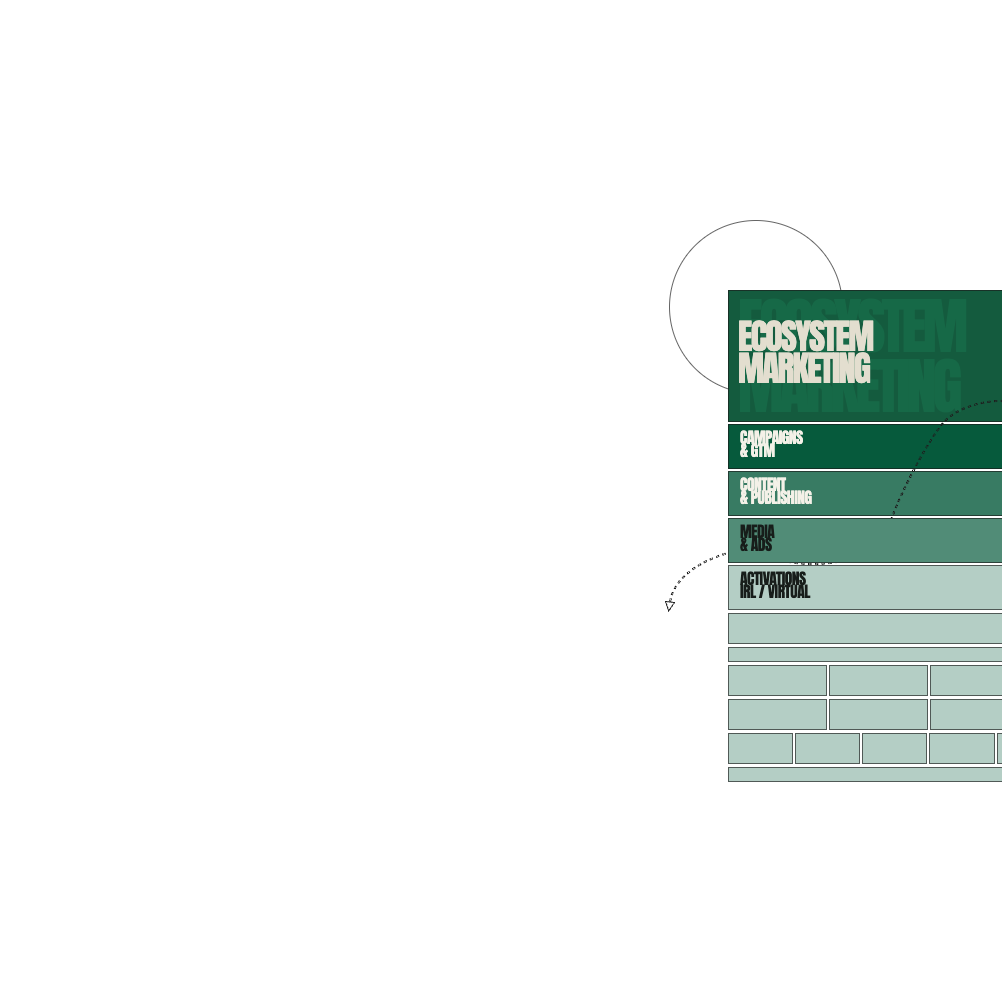

Ecosystem marketing: A New Economy Requires A New Kind Marketing

By Rai-mon Nemar Barnes April 30, 2025

It’s time to consider new ways of doing business……we offer ecosystem marketing.

The world is changing. The economy is changing. The question for most of us is how this affects our business. If it’s not only about making a buck, how do you connect in deeper ways that still make money?

Come up with a brand purpose? Try out new tactics?

Most of us are fine with connecting deeply, especially if it’s going to help make us money, but have trouble thinking of our businesses as the “cause” in cause marketing or connecting business purpose to marketing and sales.

What every brand needs more of, if it plans on doing better business, is trust. Ecosystem marketing, when done well, makes a brand worthy of that trust for the long term. It’s not concerned with your colors, logos or even your mission and vision statements—but as I like to say: Tying your values to your value as a brand is important.

Building a marketing agency that strengthens relationships, articulates value, communicates purpose and creates processes with an eye toward results, I have seen an older way of marketing that needs to be replaced with a new way of thinking and executing.

Real people don’t drop through funnels; they’re part of ecosystems.

First, if we want to truly connect, we have to stop thinking about funnels and other two-dimensional analogies for the “journeys” that customers (don’t actually) go on to find products. They’re people, and they do things in ways that may only make sense to them. They are part of living ecosystems. A marketer’s job is to pay attention to the ecosystem.

Marketing strategies used to be about shifting and keeping up, but now you should focus on connecting and investing. Old thinking says your network is your net worth, but now you have a role to play in your business networks. Remember they are ecosystems; figure out which role that is and play it well.

The benefits of reframing your thinking and authentically connecting with ecosystems can increase brand loyalty in the long run. A Harvard Business Review article notes, “A rigorous model of consumer value allows a company to come up with new combinations of value that its products and services could deliver. The right combinations, our analysis shows, pay off in stronger customer loyalty, greater consumer willingness to try a particular brand, and sustained revenue growth.”

Your brand has attention and intention. When applied in the right place, at the right time and in the right ways, it will reap benefits far beyond the old way of doing things—benefits, like trust.

Being worthy of the trust is the goal, the trust is just the reward of being worthy of it.

You can’t deepen your relationships without trust and before you can recieve trust you need to be worthy of it.  In the business world this means relentless evaluation and development of your brand, products, services and teams. Companies that provide that know their values go into communities and relationships knowing how the brand provides value as well as the value a community seeks.

The old way of thinking means thinking about people and attracting the to your funnel, as if they have no real agency and your marketing has to be powerful enough to get the to do what you’d like. Marketing  has evolved (ecosystem marketing), not it means creating a brand and product infused with your unique knowledge and experience so that you can connect deeper than anyone else could related to what you do, what you offer and who you are. Acknowledging that people will seek you and your product out when the times comes and when they aren’t seeking you out, you can and should still be building relationship with them so they’re more likely to choose you again the next time they’re in need.

When you think of markets instead of communities, you might let the market determine how you behave as a company, “the market” is hard to consider because it’s abstrct by nature. Instead, you should do the work of discovering who you are as a company, what you offer as a brand…. articulating and then communicating clearly so the entire ecosystem knows it and can feed you as they’ll know how and why you are also feeding the ecosystem.

How you market your brand and products should evolve as the economy has evolved by focusing more on values and its connection to value. In business, money is money, but time and services are also money. So giving either can prove to be a great investment and show values alignment.

Gartner describes value as not only monetary it says “ecosystems may dynamically leverage information, reputation, services, and other non-monetary forms of value.” By offering time and resources to an ecosystem, you may show the ecosystem your value to it.

Don’t be fooled. This is capitalism evolved but still capitalism.

Make no mistake: ecosystem marketing sits squarely inside of a form capitalism; it’s just not capatible with extractive forms of capitalism. Most people believe capitalism itself is extractive and if that’s the case, then ecosystem markeitng isn’t compatible. However, it’s my belief that capitalism has simple been used poorly, because of those with the nost power and influence wielding it ways that make it so.

So we’re not confused…….

Here’s what ecosystem marketing is not.

It’s not cause marketing, which is solely about the cause—and not the profit. Purpose marketing (as part of the conscious capitalism movement) is about a “higher purpose” where companies connect their profits to meaningful social causes; this is useful and meaningful but it’s not ecosystem marketing.

Ecosystem marketing is about establishing, growing and deepening relationships with the larger ecosystem which exists with or without the companies acting within it and because it’s an ecosystem, it’s imparative to create win-win-win exchanges that benefit the ecosystem as a whole.

To get any value from a relationship, you need to deepen it. By focusing on winning scenarios for primary and secondary stakeholders (employees, customers, clients, partners, communities, owners and leaders) and reducing harm for tertiary stakeholders (the planet, local neighborhoods and minorities), everyone gets more value. When people get more value, they do better in the world and can then pay more and give more back to the ecosystem in return. Which could mean, your business.

You can’t give away everything to everyone nor can you be everything to everyone, but you can go into a community (ecosystem) and be a part of it. It’s not a “one-and-done” checkbox. Ecosystem marketing needs to be done at scale and for the long term; it’s not a weekend volunteering opportunity. Figure out what a community values, and share your value there. Show up, be present, participate, listen and become a relevant member of the ecosystem.When you’re a relevant and trusted member of your ecosystem, you don’t have to ask for business. It seeks you out.